Do Snails Really Have Teeth?
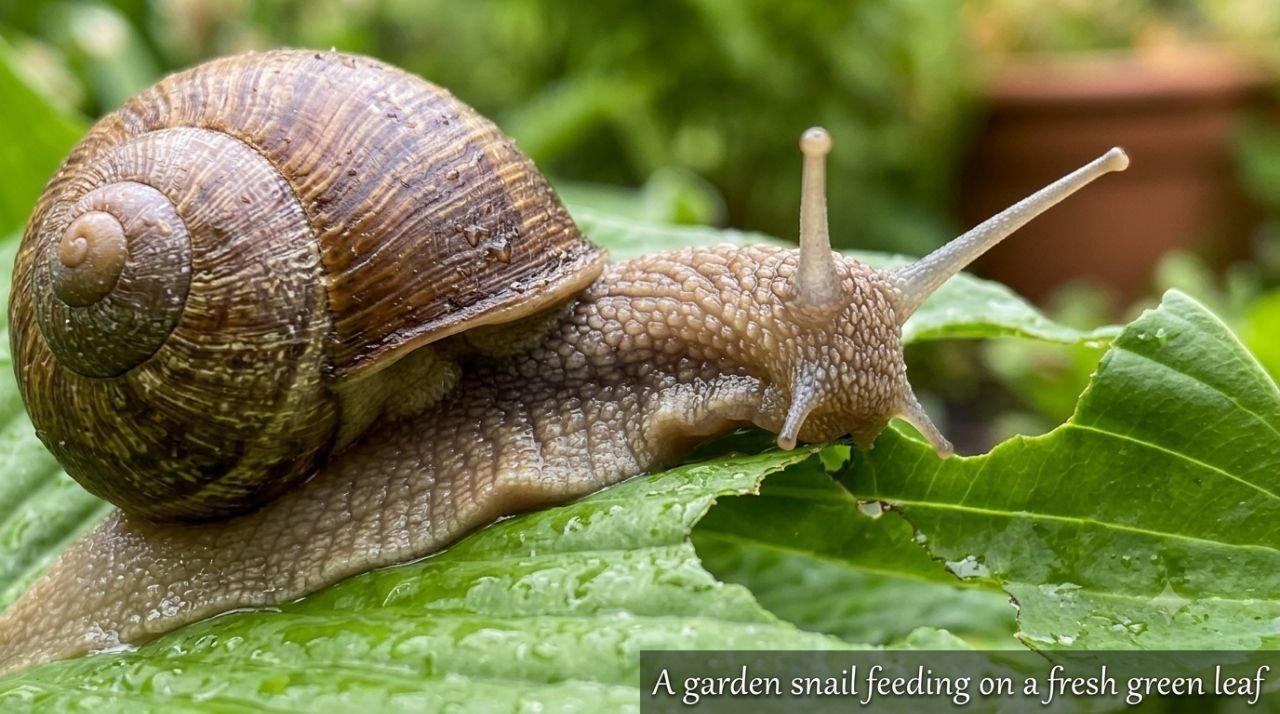
If you watch a snail eating a leaf, it can look as if it is feeding without any teeth at all. Its mouth is tiny, and you cannot see the teeth with your eyes.
But there is more going on inside its mouth.
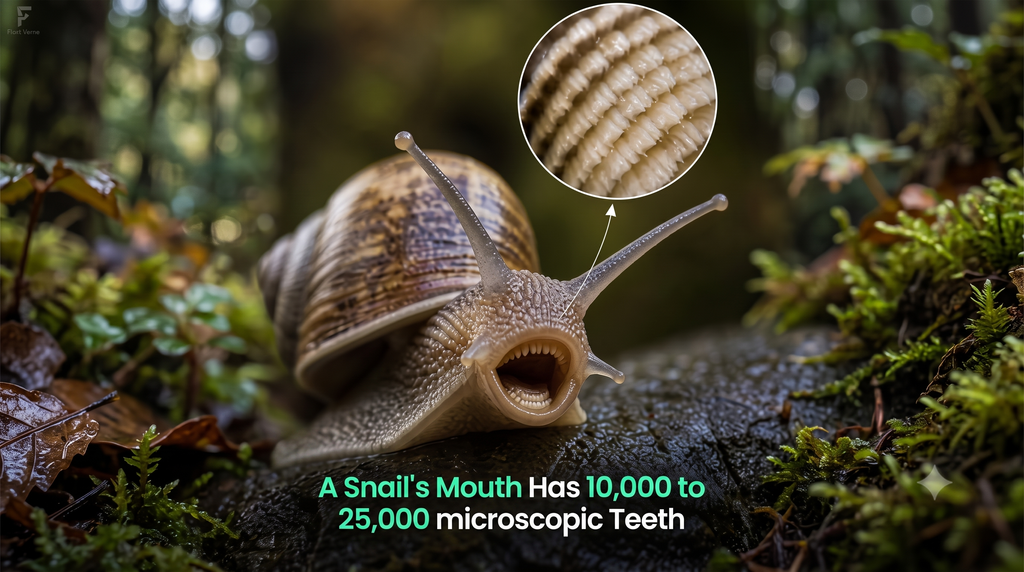
Yes, snails have teeth. Some species can have thousands of tiny tooth like structures.
They are not like human teeth, though. Our teeth are fixed in our jaws. A snail has a special feeding organ inside its mouth called a radula.
What Is a Radula?
A radula is a thin, tongue like strip inside a snail’s mouth. It has many tiny, hard teeth arranged along its surface.
The snail moves this strip back and forth against food. This lets it scrape small pieces from leaves, algae, and other food.
You can think of the radula as a tiny natural scraper inside the snail’s mouth.
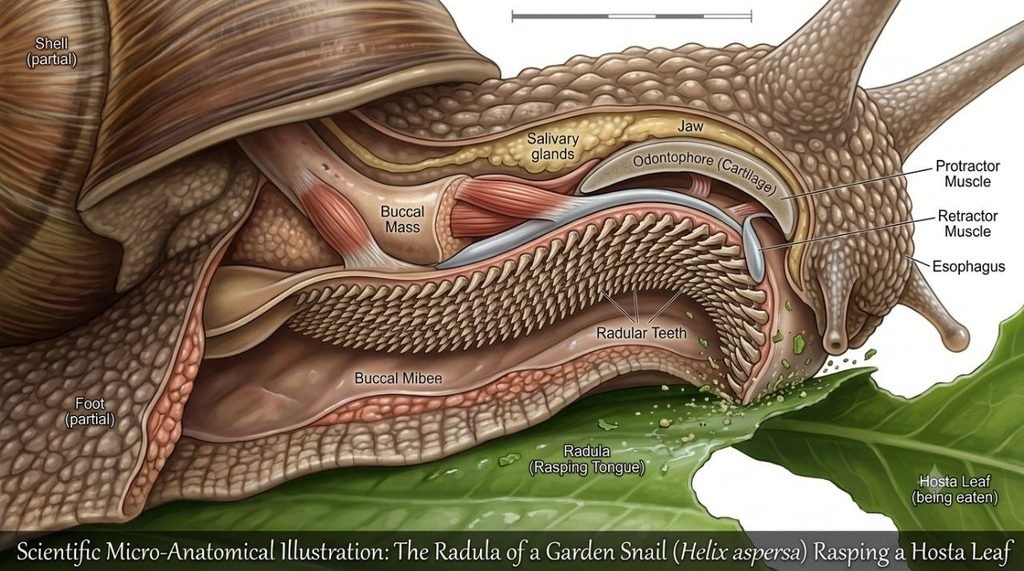
That is how a snail can slowly scrape away at a leaf instead of biting it the way we do.
What Do Snail Teeth Look Like?
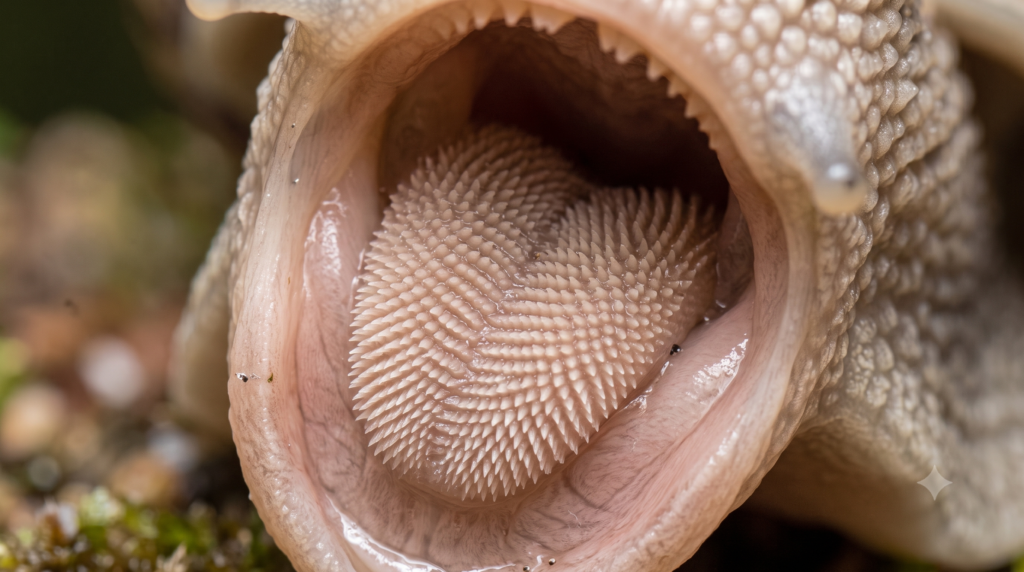
Snail teeth are so small that you normally cannot see them without magnification.
Under a microscope, the teeth appear in neat rows. In many species, there is a larger tooth in the middle with smaller teeth around it. All of these teeth are part of the radula and work together when the snail feeds.
The radula may be tiny, but it plays an important role. It helps the snail remove small pieces of food from a surface.
It is also worth knowing that not all snails have the same kind of radula. The shape, size, and number of teeth can vary depending on the species and what it eats.
So How Many Teeth Does a Snail Have?
This question does not have one simple answer.
The number of teeth varies from one snail species to another.
Some species have hundreds or thousands of tiny tooth like structures. Others can have several thousand or more. Some marine gastropods can have far more than that.
So it would not be accurate to say that every snail has exactly the same number of teeth.
The number depends on the species and the structure of its radula. It can also depend on how many teeth are present in each row and how many rows the radula contains.
For comparison, an adult human normally has 32 permanent teeth. Some snails can have thousands of tooth like structures.
There is an important difference, though. Snail teeth are not the same type of structure as human teeth, so the comparison is mainly useful for showing just how numerous they can be.
Where Do All Those Teeth Fit?
This is a common question. If a snail is so small, how can it have thousands of teeth?
The teeth are not sitting together in one large pile.
They are arranged in many small rows along the radula. Think of it as a tiny strip with rows of teeth running across it.
This arrangement allows a very small animal to have a surprisingly large number of tooth like structures in a very small space.
From the outside, a snail’s mouth looks simple. Under a microscope, its feeding system is much more detailed.
Are Snail Teeth the Same as Human Teeth?
No.
This is an important point to understand.
When we hear the word “teeth,” we usually think of the teeth in our own mouths. Human teeth are fixed in the jaw and have a hard outer layer called enamel.
The tooth like structures on a snail’s radula are very different.
They contain chitin, a strong natural material also found in the outer coverings of many insects.
The shape of these structures can also vary depending on where they are located on the radula and what the snail uses them for.
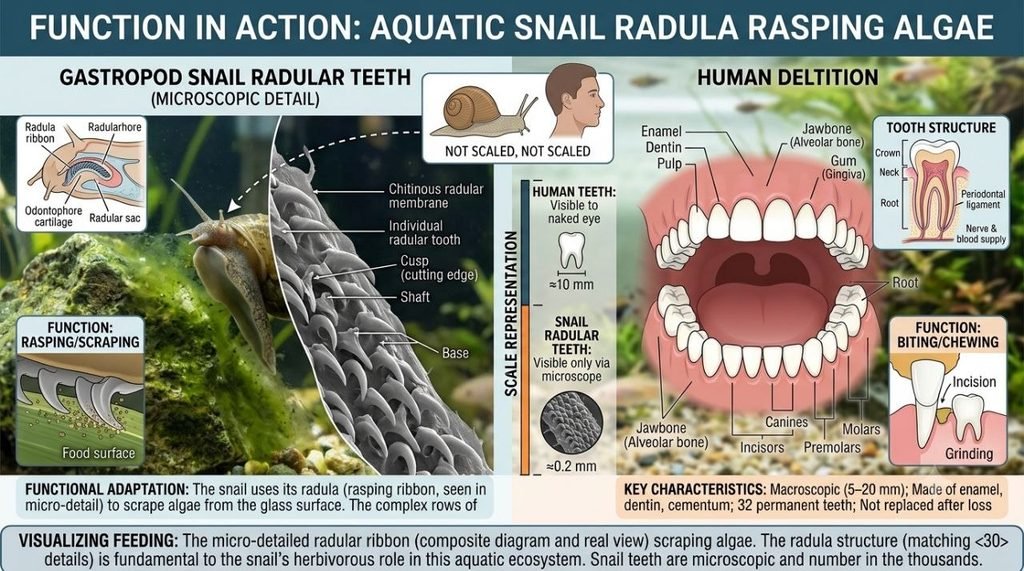
So it is fine to call them snail teeth, but they should not be thought of as tiny versions of human teeth.
Do All Snails Use Their Teeth in the Same Way?
No. Different snails eat different foods, so their radula can be adapted to different jobs.
| Type of snail | Common food | Main use of the teeth |
|---|---|---|
| Garden snails | Leaves, algae, and decaying plants | Scraping food from surfaces |
| Predatory land snails | Earthworms and other small animals | Helping hold and eat prey |
| Cone snails | Fish and other small animals | Helping capture prey |
| Herbivorous aquatic snails | Algae growing on glass and rocks | Scraping algae from surfaces |
For example, if you have ever watched an algae eating snail slowly move across the glass of an aquarium, it may look like it is simply crawling along.
It is also feeding as it moves.
Its radula helps scrape algae from the glass and other surfaces. Sometimes you may even notice faint marks where it has been feeding.
Some predatory marine snails have a very different feeding system. In certain cone snail species, specialized tooth like structures help capture prey and deliver venom.
This shows how the same basic type of feeding structure can become very different in different snails.
What Happens When Snail Teeth Wear Down?
Snail teeth wear down with use.
When a snail repeatedly scrapes leaves, algae, or other surfaces, the teeth toward the front of the radula gradually become worn.
But the snail does not simply run out of teeth.
New tooth like structures are formed toward the back of the radula. As older teeth wear down, newer rows gradually move forward.
You can think of it as a moving strip. The front part does the work, while new rows continue to come forward from behind.
The rate at which new structures develop is not the same in every species, so there is no single time period that applies to all snails.
Can a Snail Run Out of Teeth?
Under normal conditions, a snail does not use up all of its teeth simply because it keeps eating.
The reason is that new tooth like structures continue to form on the radula.
Older teeth wear down, while newer ones take their place.
This system allows the snail to keep feeding even though the teeth at the front are constantly being used.
How Can You See Snail Teeth?
If you want to observe how a snail feeds, you do not need to disturb it.
You can try a few simple things:
- Watch a snail feeding normally on a leaf.
- Look closely at the surface after it has been feeding. You may notice faint scraping marks.
- If you have a magnifying glass or microscope, you can try to examine the radula.
Do not touch the snail’s mouth or disturb it just to examine its teeth.
Watching a snail feed naturally is the simplest and safest way to understand how its feeding system works.
Why Does the Number of Snail Teeth Vary So Much?
The main reason is that not all snails live or feed in the same way.
Some eat leaves and algae. Others scrape food from hard surfaces. Some species are predators and have a very different way of feeding.
Because their diets and lifestyles are different, their radula can also be different.
The number, shape, and arrangement of the teeth can therefore vary from one species to another.
So if you find different numbers reported for snail teeth, that does not necessarily mean one of the numbers is wrong. The information may simply be referring to different species.
Final Thoughts
So, how many teeth do snails have?
The simplest answer is that it depends on the species.
Some snails can have thousands of tiny tooth like structures. These are not fixed inside a jaw like human teeth. Instead, they are arranged in rows along a small feeding organ called the radula.
The snail moves the radula back and forth to scrape food from a surface. As the older teeth wear down, new tooth like structures form behind them and gradually move forward.
A snail may look like a very simple animal from the outside, but its feeding system is surprisingly well organized.
The next time you see a snail feeding on a leaf, remember that there is much more happening inside that tiny mouth than you can see.
Frequently Asked Questions
Do snails have teeth?
Yes. Snails do not have teeth fixed in a jaw like humans, but they have a radula covered with many small, hard tooth like structures. These help them scrape food and remove small pieces from surfaces.
How many teeth does a snail have?
There is no single number for all snails. The number of tooth like structures varies greatly between species. Some snails have thousands of them, while other gastropods can have many more.
What are snail teeth made of?
The tooth like structures on a snail’s radula contain chitin, a strong natural material that is also found in the outer coverings of many insects.
Do snail teeth grow back?
Yes. The teeth at the front of the radula gradually wear down during feeding. New tooth like structures form farther back and slowly move forward to replace the older ones.
Do slugs have teeth too?
Yes. Slugs also have a radula with small tooth like structures. Their number and shape can vary depending on the species and what the slug eats.

1 Comment